
You've hired a Google Ads agency, or you're about to. Then the first month starts, and it can feel like a black box: money is going out, and you're not sure what should be happening, or when.
This guide sets out what to expect from a Google Ads agency in the first 30 days, week by week: onboarding and access, tracking, the account audit, strategy, launch, the learning period and your first report. It's written for owners and managers of Canadian small businesses in automotive, multi-location retail, construction and the trades.
Use it as a yardstick for any agency, including us. Exact timings vary from account to account. The order of the work shouldn't.
What to expect from a Google Ads agency before launch
Good Google Ads work starts with your business, not with keywords. Expect a proper discovery conversation that covers:
- Your goals: calls, quote requests, booked appointments or online sales.
- Your margins: which services you actually want more of.
- Your service areas: the cities, regions or store catchments you can realistically serve.
- What a lead is worth: how many leads become jobs, and what a job is worth. This sets a sensible cost per lead.
- Who handles leads: who answers the phone and replies to forms, and how fast.
Next comes access. Google Ads lets you give each user a set access level (Admin, Standard, Read-only, Billing or Email-only), so a good agency tells you exactly what it needs and why. Expect requests for Google Analytics, your Google Business Profile and your website too, because tracking touches all of them.
Scope, goals and timeline should be written down before any campaign goes live. At IKSHARP, every project begins with a clearly defined scope, objectives and timeline, set up in Zoho Projects, where timelines, tasks and deliverables are shared and tracked. Our discovery is consulting-led: we review your objectives, your sales and marketing process and what realistic performance looks like. We recommend business consulting before campaigns run, so you can start with a strategy session. See our business consulting service.
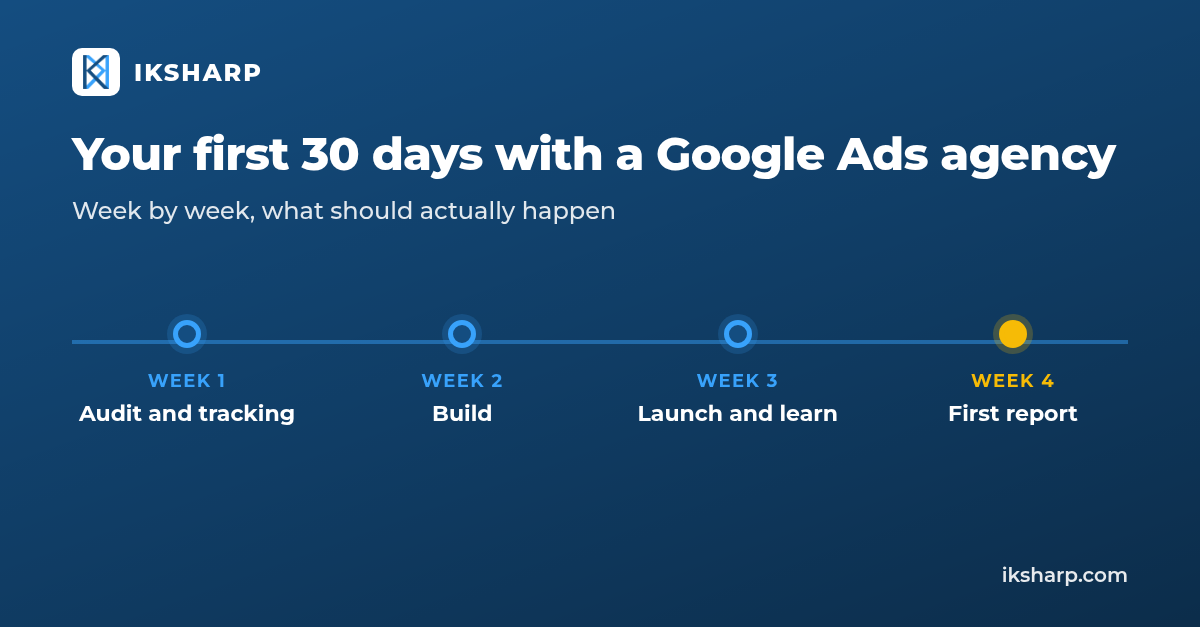
Week 1: account audit and tracking
The audit, or a fresh build. An existing account should be audited before anything changes: which conversions are counted, which searches you've paid for, how campaigns are structured and where the ads send people. New account? Week 1 is for planning the build.
Conversion and call tracking. This is the most important job of the first month. Google Ads can count:
- Website actions, like form submissions, bookings and purchases.
- Phone calls: calls from your ads, calls to the number on your website, and taps on your number on the mobile site.
- Offline conversions uploaded from a file or another system, one way to tell Google which leads became real jobs.
For calls from ads, you can set a minimum call length, so hang-ups and wrong numbers don't count as conversions.
Google Analytics 4. Your agency should link Google Analytics to Google Ads, so events marked as key events can be used as conversions.
Test everything. Submit every form, make a test call and complete a booking. Check each one is recorded and reaches a real person. Leads sitting in an unread inbox help no one, which is where lead follow-up comes in.
Why the fuss? Automated bid strategies such as Maximize Conversions optimize toward the conversions you tell Google Ads about. Count the wrong thing, and the system gets very good at buying the wrong thing.
Week 2: campaign build
- Keyword themes by service and area. "Winter tire installation" and "wheel alignment" get their own ad groups and ads, matched to where you work.
- Negative keywords. These stop your ads showing on searches you don't want, like jobs or DIY. Negative keywords don't match close variants, so plurals and synonyms need adding separately.
- Ad copy that speaks to the service searched for, with a clear reason to call or book.
- Landing-page fit. The page should say what the ad said, work well on a phone, and make calling or booking easy.
- Settings: location targeting that matches your service area, an ad schedule that matches when someone can answer the phone, and a daily budget in CAD.
A note on Local Services Ads. In Canada, Google's Local Services Ads are available only for certain categories, including plumbers, electricians, HVAC, roofers, locksmiths and movers. They appear in Google Search results, and you pay for leads rather than clicks. If your trade is on Google's list, ask whether they're worth running alongside Search.
Week 3: launch and the learning period
Launch. Every new ad goes through Google's review. Google says most ads are reviewed within one business day, though complex reviews can take longer.
The learning period. With an automated bid strategy, you may see a "Learning" status. Google shows it when a bid strategy is new or reactivated, when a setting changes, or when campaigns, ad groups or keywords are added or removed.
According to Google, how long it lasts depends on how many conversions the campaign gets, how long your conversion cycle is (the time from click to conversion) and which bid strategy is used. It can take a few conversion cycles, typically one to two, and can be faster with more conversion data. It doesn't apply to Manual CPC. Google also notes that key metrics may vary during learning, so you may not want to judge performance until it's over.
A good agency warns you that early numbers will move, fixes clearly broken things fast (tracking faults, irrelevant searches) and avoids stacking big changes, since bid strategy changes can put a campaign back into learning.
Reading early numbers. Google Ads' standard conversion columns report conversions against the date of the ad click. So the last few days in a report can still rise as late conversions come in.
Week 4: first optimization and first report
By week 4 there's real data. Expect:
- Search-term cleanup: reviewing the actual searches that triggered your ads and excluding the ones that don't fit.
- Bid and budget shifts toward the services, areas and times producing leads.
- Ad and landing-page tweaks based on what people clicked and did next.
- A lead-quality check with you: which calls and forms were real prospects.
You shouldn't wait 30 days to hear how things are going. At IKSHARP, you get progress reports every 15 days and one pre-planned meeting every week to discuss progress, priorities, challenges and decisions. Whoever you hire, agree the reporting cadence in writing before launch.
Google Ads onboarding checklist
- Goals, service areas and the value of a lead agreed in writing
- Access to Google Ads, Google Analytics, Google Business Profile and your website
- Conversion actions defined: forms, calls, bookings, sales
- Every form, call and booking path tested end to end
- Leads routed to a named person, with a follow-up routine
- Keyword themes by service and area, plus starting negative keywords
- Ads and landing pages matched service by service
- Location, ad schedule and budget settings checked
- Reporting cadence and meeting schedule agreed
- First report date in the calendar
What results look like after the first month
Month one sets the baseline. It isn't the verdict.
Leading indicators come first: cost per lead, conversion rate, call quality, and whether search terms match what you sell.
Lagging indicators take longer: booked jobs, revenue and return on ad spend. They depend on your sales cycle and on connecting leads to outcomes, which is where CRM data and offline conversion imports help.
For context on what builds over time: paid campaigns for a multi-location tire retailer in Canada bring in 500+ leads a month. That built up over months, not four weeks, and every business is different.
PPC agency red flags
- No tracking check. Spend starts before anyone tests your forms and calls.
- No report, or numbers with no explanation of what changed and why.
- No named contact. You don't know who is working on your account.
- Guaranteed results. No one can guarantee a position, a lead count or a return.
- Vanity metrics only. Impressions and clicks, with no mention of leads, cost per lead or lead quality.
FAQ
How long before Google Ads works?
Ads can start showing once they pass review, which Google says happens within one business day for most ads. Judging performance takes longer: with an automated bid strategy, Google says learning typically takes one to two conversion cycles, depending on conversion volume. Treat month one as the baseline, and be wary of anyone who promises results by a set date.
How much should I spend in month one?
There's no single right number. Work backwards from how many leads you want, roughly what a click costs for your services in your area, and how many clicks become leads. Your agency should walk you through that estimate in CAD. Also note that on any day a campaign can spend up to twice its average daily budget, but over a month it won't spend more than 30.4 times that amount. Ad spend and agency fees are usually separate, so ask how yours is set up.
What should my first report show?
Spend in CAD, conversions by type (calls, forms, bookings), cost per lead, top search terms and what was excluded, what changed and why, whether bid strategies are still learning, and the plan for the next two weeks. It should also reflect your feedback on lead quality.
Talk to us about your first 30 days
Hiring an agency, or unsure your current one is on track? We'll walk through your goals, your tracking and what a realistic first month looks like. Learn more about our performance marketing services.
Book Appointment